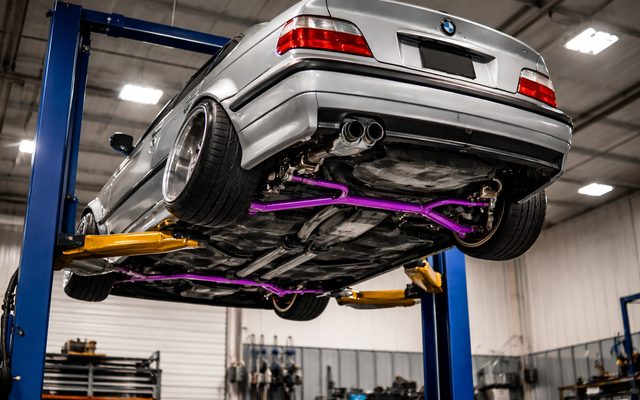
In the demanding realm of today's professional oversteer competition, success is not merely purely a product of sheer horsepower or pilot aggression. Conversely, it has become a intricate engineering challenge that requires a scrupulous fusion of choosing a proven vehicle platform, arming it with the highest-quality performance parts, and, most essentially, understanding its real-time performance on the course through advanced vehicle dynamics analysis tools. This definitive guide will serve as your blueprint from the very first idea of a competition vehicle all the way to the final telemetry-optimized tweaks that turn a strong machine into a predictable podium finisher. We will examine in detail the methodical process of vehicle alignment optimization, illustrating how a state-of-the-art drift tuning app like precise measurement hardware eradicates guesswork and provides unparalleled insight into your vehicle's true performance.
The foundation of any great drift car is, without question, the chassis itself. Certain platforms have achieved renowned standing within the international sliding culture due to their built-in balance, durable design, and the vast ecosystem of aftermarket parts available. Choosing the optimal platform is the initial and most significant selection a driver will make. To illustrate, the BMW's E36 3 Series is universally acknowledged as among the finest overall drift platforms of all time. Its near-perfect balanced front-to-rear weight, alongside a RWD setup and bulletproof straight-six engines, creates a chassis that is simultaneously accessible for novices and extremely competitive in the control of a pro pilot. The successor of this concept, the E46 model BMW, improves on these attributes with a even more developed frame, increased stance for enhanced stability, and still more lock straight from the manufacturer. A distinct powerful platform in the professional scene is the Chevrolet Corvette C6.
This V8-powered track weapon offers a unique combination of benefits to the drifting discipline, including a low-mass aluminium chassis, a backwards-positioned transaxle that aids in an excellent balance, and the tremendous torque of a powerful LS-series V8 engine. This blend makes it an utter weapon on track, able of starting and sustaining long angles with apparently effortless use of power. For drivers desiring remarkable bang-for-the-buck, the Nissan Z33 rises above as a prime candidate. It comes from the manufacturer with a robust chassis, a effective original LSD, and the responsive VQ35DE powerplant that provides plenty of performance for learning and advancing in the activity. Its newer version, the 370Z model, presents additional improvements in body strength, handling precision, and outright powerplant power, solidifying its status as a common choice among serious competitors. Other historic platforms that merit attention are the lightweight rotary-powered Mazda FC RX-7, the most popular Nissan S13, the V8-powered Ford SN95, the more recent BMW E90, and the tiny yet surprisingly fun and instructive Mazda MX-5. Each of these chassis offers a distinct palette of traits, challenges, and possibilities, but they all share the fundamental components necessary to become a serious sliding vehicle.
However, selecting the optimal chassis is just the beginning. To access the complete performance of every of these cars, substantial changes to the steering system and chassis control systems are completely essential. This is where the domain of precision aftermarket parts comes into sharp importance. The most most transformative modification for a serious drift machine is the fitting of a high-performance drift angle kit. These engineered assemblies, such as those developed by industry leaders like SLR Speed, are engineered to dramatically enhance the chassis's possible lock-to-lock rotation. A OEM road car is highly limited in how far its front wheels can turn, a engineering trade-off for public road driving. In drifting, however, maximum steering input is constantly necessary to control and sustain a slide. An angle kit substitutes the stock hubs, tie rods, and often suspension arms with pieces that permit the wheels to achieve degrees of turn over 70 or even 80 degrees, compared to a average stock angle of around 40 to 50 degrees.
This vastly increased lock gives the pilot with dramatically greater authority during a drift, allowing it to be considerably simpler to start a slide, maintain it through a extended bend, and transition seamlessly from one side to another. The contrast in handling is nothing short of transformative. Combined with a properly selected modification is the equally essential modification to the chassis's suspension. Store-bought or including expensive road coilovers are just not designed for the specific and brutal requirements of drifting. A purpose-built system of adjustable dampers is of utmost importance. These specific suspension components feature unique valving and spring stiffness that are optimized for the rapid mass transition that is characteristic of aggressive driving. When a pilot begins a drift, the car's inertia is shifted rapidly to the outside of the bend. Correct drift-spec suspension control this transfer in a controllable manner, permitting the car to settle promptly and providing the operator precise feedback through the controls and seat. They furthermore enable precise setting of ground clearance, damping firmness, and corner weighting, which are all key parts of fine-tuning the chassis's dynamics to a particular circuit or driving style. As a system, a top-tier steering angle kit and a correctly specified pair of performance adjustable dampers form the absolute hardware base upon which all subsequent refinement is built.
Once the essential components is installed, the subsequent essential stage in the project is the precise tuning of the car's suspension geometry. This is the domain of chassis dynamics adjustment, a methodology that can feel overwhelmingly complex to the beginner but is, in practice, the defining factor to converting a assembly of high-performance components into a unified and predictable whole. The most discussed element of alignment for drifting is undoubtedly camber angle. Camber angle is the tilt of the wheel in relation to the upright line when viewed from the front of the car. If the top edge of the tire is tilted inward, this is known as inward tilt. In drifting, negative camber on the front axle wheels is generally employed and is considered necessary. The logic is intrinsically tied to vehicle dynamics.
When a chassis is going around a bend at limit sideways angles, the body leans to the outside of the bend. This body roll makes the outer front tire to reduce its best footprint with the asphalt. By introducing an inward tilt, the wheel is pre-angled to compensate for this lean. As the vehicle tilts into the corner, the tire gains a better contact patch against the track, optimizing its traction at the precise point when it is most required for steering authority. Commonly, front axle camber settings for a competition drift machine range from approximately -3 degrees to as high as -5 degrees or even greater, depending on the details of the chassis setup, compound choice, and operator style. The back wheels also use inward tilt, but the settings are generally less and subtler than the front. Excessive camber at the back can result in the chassis extremely prone to oversteer and challenging to manage on power application, as it reduces the usable contact patch of the driven tires during forward power delivery. Therefore, rear adjustments are frequently in the ballpark of -1 degree to -3 degrees, striking a delicate equilibrium between providing adequate lateral bite to help in entering and sustaining the slide while still keeping good traction for exiting the bend. camber angle is just one component of the broader alignment puzzle, which additionally includes toe setting, caster angle, and steer correction modification.
Toe setting refers to the angle of the wheels as seen from the top. Inward toe means the leading edges of the tires are nearer together than the trailing edges, while negative toe means the converse. For oversteer, a slight amount of front toe out is frequently employed to quicken the initial directional response, making the chassis feel more nimble and eager to begin a slide. Rear axle toe setting is generally set to neutral or a very small amount of toe-in to foster predictability under throttle. caster angle is the longitudinal or backwards tilt of the kingpin axis when looked at from the lateral of the car. More caster enhances steering feel and high-velocity confidence, and it also increases camber effect during turning, which is highly beneficial. Setting these settings is a complex interplay where a modification to one setting can and often will impact the others. The traditional process for tuning a chassis's suspension geometry for competition has historically been a time-consuming affair of guesswork and adjustment. A tuner or engineering group would introduce a adjustment based on experience, test the vehicle on track, depend on the operator's subjective feel and feedback, and then apply an additional change. This loop would continue again and again until the vehicle felt "right" or the allotted testing time ended. This system is not just incredibly wasteful in terms of hours and tires, fuel, and parts, but it is also fundamentally flawed.
Human sensation is a famously inconsistent metric, influenced by countless factors such as tiredness, evolving track conditions, weather, and merely the mindset of the pilot on that particular day. What feels "tail-happy" on one pass might feel "understeery" on the next run, resulting in conflicting feedback and frustrating tweaks. This long-standing challenge in vehicle dynamics optimization is specifically where contemporary engineering tools has intervened to transform suspension tuning tool the methodology.
The rise and integration of specialized vehicle dynamics tools has ushered in a completely new age for building and refining competitive sliding vehicles. These platforms, represented by innovative systems like modern telemetry hardware, work by physically measuring the live dynamic behavior of the vehicle as it is piloted on the circuit. Unlike using subjective impression, these devices collect measurable information on critical variables such as damper compression and extension, wheel speed, G-force loading, wheel angle, and driver input position. This collected information flow is then analyzed by advanced algorithms that can graph and decode the information in a comprehensible way. For the first time, tuners and teams can visualize exactly what the car is exhibiting at each point of a drift. This capability changes the whole chassis setup procedure. Think about the aforementioned task of setting the front axle camber for a specific chassis. As an alternative to making a change from -3 degrees to -3.5 degrees and then driving many passes to try and "sense" a difference, a suspension tuning tool can provide real-time and definitive data. The application can show graphically how the suspension's contact patch is acting during the key moments of a slide: initiation, mid-corner, and transition. It can demonstrate if the existing camber setting is allowing the outside front tire to keep ideal grip or if the compound is working inefficiently on its outer edge.
The tool can after analysis make data-driven suggestions for change. Perhaps the information reveals that the outside front tire is even overworking its sidewall at -3.5 degrees of negative camber, implying that a move towards negative camber, say -4 degrees, might be beneficial. Conversely, the data might show that the tire is not achieving heat or that the inner shoulder is wearing excessively, which could suggest that there is excessive angle and a small lessening back to -3.2 degrees would be better ideal. This level of precision and useful intelligence was completely unimaginable in the time of exclusively mechanical adjustment.
The benefit of using a dedicated drift telemetry system goes far beyond only dialing in camber. It functions as an invaluable coilover setup tips that is tailored to your specific car. When adjusting the rebound and compression settings on your suspension, instead of relying on general advice or mimicking another car's setup, you can use the telemetry to observe how the vehicle is performing in reaction to your adjustments. The software can show the suspension travel path over a run, highlighting if the dampers are handling the weight transfer properly car suspension tuning or if they are allowing the chassis to oscillate uncontrollably after a transition. It can assist in identifying problems like bottoming out or losing droop, allowing you to make informed decisions to preload settings, rebound/compression values, or ground clearance. This process extends equally to the intricate process of corner balancing. Beyond camber angle, the software can provide data into how adjustments to toe settings and caster are influencing the vehicle's stability during specific maneuvers of a drift. For example, it can help you to determine the best car alignment tuning amount of front toe out for your specific steering rack setup and piloting style by analyzing the response time of initial reaction and the predictability of the vehicle at full lock. This turns the software an incredibly effective performance optimization handbook that is actively calibrated by the actual performance of your own car on the tarmac. It moves the whole process from a subjective skill into a methodical engineering process.
Furthermore, the value of a tool like data acquisition is not at all confined to expert engineers with vast resources. For the club-level driver, it acts as an amazing equalizer. It in essence offers the builder with the analysis of a full-time suspension specialist without needing the corresponding cost. It accelerates the learning curve by providing clear answers to challenges that would traditionally take countless track days of experimentation to solve. A tuner can understand how their individual car reacts to different settings, gaining a more profound comprehension of car control in the endeavor. It additionally democratizes high-level chassis dynamics principles, permitting anyone with the ambition to perfect their machine to accomplish it in a structured and effective way. This is notably important in a sport like drifting, where tuning expertise has traditionally been a closely guarded asset among professional teams. Now, that capability can be in the toolkit of every dedicated enthusiast.
In conclusion, the path to engineering and tuning the ultimate competitive drift car is a comprehensive mission that seamlessly combines classic hardware principles with revolutionary telemetry technology. It commences with the strategic selection of a legendary platform, followed by the installation of critical performance components like high-performance drift angle kits and expertly valved competition suspension units. The build then moves into the precision realm of car suspension tuning, where settings like camber angle, toe setting, and caster are carefully adjusted to match the chassis's upgraded geometry and the driver's specific technique. Ultimately, and what genuinely distinguishes the contemporary methodology from the old ways, is the adoption of a advanced suspension tuning application. This platform removes the guesswork and trial and error of solely feel-based tuning by giving quantifiable, real-time information on how the car is actually functioning. It serves as an incredible engineering partner, a definitive coilover setup manual, and a all-in-one chassis development system. In unison, this complete approach ensures that all aspect of the competition vehicle—from the choice of the car to the last click on the coilover—is optimized for peak performance on the track. It signifies the full maturation of the sport of sliding, bridging physical pilot talent with surgical vehicle setup to build the perfect effective cars attainable.